At the University Radiology Vein Center, patients can have
the very latest treatment for varicose and spider veins. Our team of
Interventional Radiologists specialize in EVLT (Endovenous Laser Treatment),
the state-of-the-art technology used to eliminate bulging varicosities
and associated pain. Our physicians also perform sclerotherapy, ambulatory
phelbectomy, and the other cosmetic procedures used to create more attractive
legs.
For additional information about these procedures, please call 732-246-0060.
Background information about EVLT is included below.
EVLT for Varicose
Veins (Endovenous Laser Treatment)
A safe, effective and painless remedy for varicose veins.
- State-of-the-art high-tech procedure performed with local anesthetic
- No hospitalization
- Comfortable office setting
- Treatment in less than an hour
- Immediate relief of symptoms
- Activities can be resumed right away — with little or no pain
- Excellent clinical and aesthetic results
Frequently Asked Questions about EVLT
What causes varicose veins?
Malfunctioning valves create the twisted bulging veins that result
in the
discomfort and embarrassment of varicose veins. As blood flows through
your veins
to the heart, stop valves close to prevent the blood from flowing backwards
from the pull of gravity. If the valves do not close properly, blood
pools in
the vein, forcing the walls to enlarge and bulge out. Symptoms caused
by
varicose veins include aching pain, leg fatigue and leg heaviness,
all of which
worsen as the day progresses.
How are varicose veins treated?
Traditionally, surgical ligation or vein stripping was the treatment
of
choice. Vein stripping is a surgical procedure that produces scarring,
may require
a long recovery time and can be quite painful. Repeat surgery is sometimes
necessary. Treatments also used are injection sclerotherapy or phlebectomy.
These
procedures do not address the source of the larger varicosities which
are caused by
venous reflux in the saphenous vein.
Saphenous vein reflux can be treated with ablation of the vein with
radiofrequency waves. Treatment with radiofrequency is less invasive
than vein
stripping, but requires a long procedure time and in some clinical
research studies
has resulted in more complications.
Is there a better option?
Now, there is a new technique performed by
specially trained physicians
called EVLT,® (EndoVenous Laser Treatment) that is safe, fast and
effective. This
minimally invasive procedure addresses the underlying source of the
problem
with less pain, shorter recovery times, greater success rates, less
cost and
greater convenience.
EVLT is performed using only local anesthetic in a comfortable outpatient
office setting, rather than in a hospital. The treatment can typically
be
performed in less than an hour and has minimal to no recovery time.
Activities can be
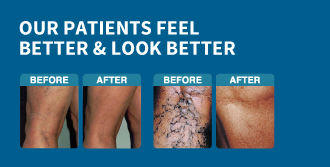
resumed right away — with little or no pain. Excellent clinical
and aesthetic
results with no scarring can be expected.
How successful is this treatment?
Published clinical studies show that EVLT has a 98% initial success
rate with
excellent long-term results.
Is loss of this vein a problem?
No. After treatment, the blood in the diseased veins will be diverted
to the
many healthy veins in the leg, reestablishing normal flow.
What can I expect during this treatment?
First, duplex
ultrasound is used by our physicians who are specially trained
and experienced in minimally invasive interventional radiology to map
the
greater saphenous vein and examine the deep and superficial venous
systems. After
a local anesthetic is applied, the doctor uses imaging guidance to
insert a
thin laser fiber into the diseased vein through a tiny entrypoint,
usually near
the knee. Laser energy is delivered to seal the vein. These procedures
will be
painless.
Walking immediately after the procedure is encouraged. Normal daily
activity
can be resumed. There may be minor soreness and bruising. Any discomfort
can
be treated with over-the-counter, non-aspirin pain relievers as needed.
Does insurance cover this treatment?
Many insurance carriers cover
this procedure, based on the medical necessity
for the relief of symptoms.
What should I do next?
Call us at 732-246-0060 with any questions.
At that time we can schedule your
visit.
|